UiPath Automation Cloud vs On-Premise: Which Automation Model Is Right for Your Business?
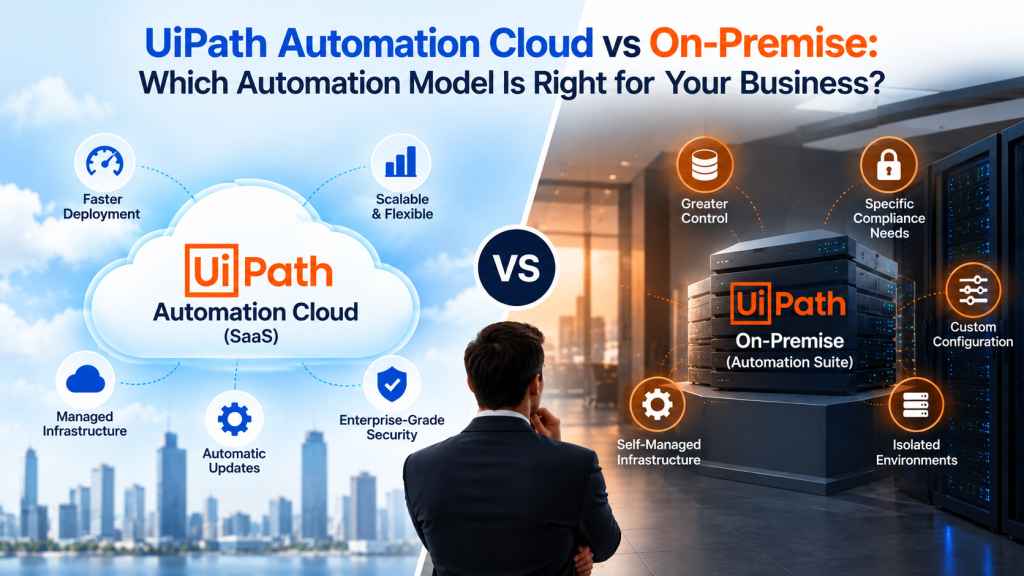
Enterprise automation has moved well beyond simple task automation. Today, CTOs, CIOs and transformation leaders are looking for automation platforms that can scale across departments, integrate with enterprise applications and support long-term digital transformation.
For organizations considering UiPath, one important decision comes early: should you deploy your automation platform through UiPath Automation Cloud or use a self-hosted deployment such as UiPath Automation Suite?
This guide compares both approaches to help enterprise decision-makers determine which model fits their automation strategy.
What Is UiPath Automation Cloud?
UiPath Automation Cloud is UiPath’s fully managed SaaS platform for designing, deploying, operating and scaling enterprise automation. UiPath manages the underlying infrastructure, platform maintenance and updates, allowing organizations to focus primarily on building and running automations.
Automation Cloud also provides centralized governance and regional deployment options. Depending on requirements, organizations can use standard Automation Cloud, Automation Cloud Public Sector or Automation Cloud Dedicated.
For enterprises that want to avoid managing automation infrastructure themselves, this can significantly simplify deployment and ongoing operations.
What Is UiPath On-Premise Automation?
When organizations choose a self-hosted UiPath deployment, UiPath Automation Suite is the primary platform for enterprise automation workloads.
Automation Suite allows organizations to deploy UiPath on their own infrastructure, including on-premises virtual machines, bare-metal environments or supported cloud infrastructure. It supports production deployments with capabilities such as high availability and scaling.
This approach gives the organization substantially more control over its infrastructure and environment—but that control also comes with greater responsibility for deployment, maintenance, upgrades, security and infrastructure management.
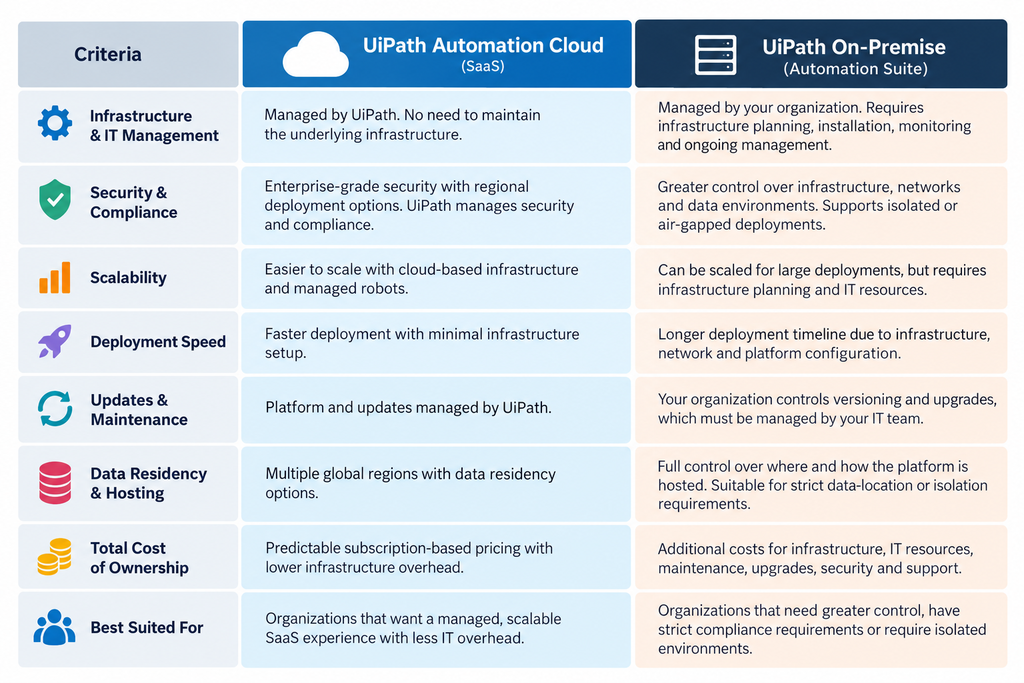
Key Differences: Automation Cloud vs On-Premise
The right deployment model depends on how much control your organization needs versus how much infrastructure management it wants to take on. Here are the key factors enterprise technology leaders should consider.
Infrastructure & IT Management
Automation Cloud is managed by UiPath, reducing the need for your IT team to maintain the underlying automation infrastructure. Automation Suite, on the other hand, requires your organization to manage infrastructure, installation, monitoring, upgrades and ongoing operations.
Security & Compliance
Both approaches can support enterprise security requirements, but they offer different levels of control. Automation Cloud provides UiPath-managed security and regional deployment options, while Automation Suite gives organizations greater control over infrastructure, networks and data environments—including support for isolated or air-gapped deployments where required.
Scalability
Automation Cloud makes it easier to scale automation without having to provision and manage the underlying platform infrastructure. With Automation Suite, enterprises can also build highly scalable environments, but scaling typically requires additional infrastructure planning and IT resources.
Deployment Speed
Cloud deployment generally reduces infrastructure setup and can help organizations get automation initiatives running faster. On-premise deployment involves more planning around servers, networking, security and platform configuration, which can increase implementation time.
Updates & Maintenance
With Automation Cloud, UiPath manages the platform and its underlying infrastructure. With Automation Suite, your organization has greater control over versioning and upgrade schedules, but your IT team is also responsible for carrying out those upgrades and maintaining the environment.
Data Residency & Hosting
For organizations with specific data-location or hosting requirements, the deployment model becomes particularly important. Automation Cloud offers regional cloud options, while Automation Suite allows enterprises to determine where and how the platform is hosted, making it suitable for organizations with strict infrastructure or isolation requirements.
Which Automation Model Should Your Business Choose?
There is no universal answer.
Automation Cloud may be suitable when you:
- Want faster deployment
- Prefer SaaS over infrastructure management
- Want to reduce IT maintenance overhead
- Need to scale automation across business units
- Want access to managed cloud infrastructure
- Operate across multiple regions
- Prefer UiPath-managed platform updates
Automation Suite may be suitable when you:
- Require greater infrastructure control
- Have strict hosting or data-location requirements
- Need an isolated or air-gapped environment
- Have an established infrastructure and DevOps team
- Need greater control over upgrades and platform configuration
- Have specialized security or network architecture requirements
UiPath specifically supports offline Automation Suite deployments for completely isolated environments, although these introduce additional infrastructure and operational complexity.
Conclusion: Choosing the Right UiPath Deployment Model
UiPath Automation Cloud and Automation Suite address different enterprise priorities.
Automation Cloud is designed for organizations that want a managed, scalable SaaS experience with less infrastructure responsibility. Automation Suite is designed for organizations that need greater control over their hosting environment, infrastructure and deployment architecture.
For many enterprises, the decision ultimately comes down to one fundamental question:
Do we want our IT team to manage the automation platform—or do we want UiPath to manage the platform while our team focuses on automation outcomes?
The right choice should be based on your organization’s security posture, compliance requirements, infrastructure capabilities, automation roadmap and total cost of ownership. If you’re evaluating UiPath for enterprise process automation, a structured assessment of your existing processes, applications, infrastructure and compliance requirements can help determine the most appropriate deployment approach before implementation begins.
Provitious can help enterprises assess their automation landscape, identify suitable processes and design UiPath-based automation solutions aligned with their technology and business requirements. Drop an email on info@provitious.com