Automating Purchase Orders and Customer Schedules in Manufacturing with RPA
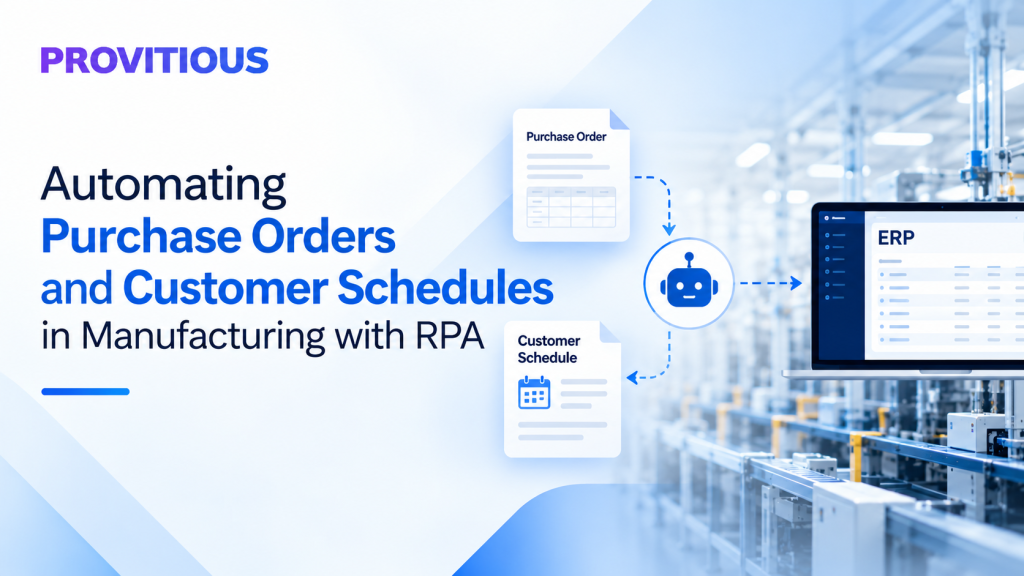
Manufacturing enterprises manage a constant flow of purchase orders, customer schedules, delivery forecasts, and order updates across multiple systems. Processing these documents manually can create operational bottlenecks, increase data-entry errors, and delay production and delivery planning.
As supply chains become more complex, manufacturers need faster and more reliable ways to manage business-critical information. Robotic Process Automation (RPA) enables manufacturing companies to automate repetitive tasks, streamline document processing, and improve data accuracy across existing enterprise systems.
By automating purchase orders and customer schedules, manufacturers can reduce manual intervention, accelerate order processing, and improve coordination between procurement, production, inventory, and customer service teams.
What Is Purchase Order and Customer Schedule Automation?
Purchase order automation uses software bots to process purchase orders, validate relevant information, update business systems, and reduce repetitive manual work. Depending on the workflow, automation can capture order details from emails and attachments, verify required fields, and transfer validated information into an ERP system.
Customer schedule automation focuses on processing delivery schedules, forecast updates, and order releases received from customers. These schedules help manufacturers plan production, manage material requirements, and meet delivery commitments.
With RPA in manufacturing, businesses can automate repetitive activities across these workflows without necessarily replacing their existing ERP or introducing extensive changes to legacy systems.
Why Manufacturing Companies Need Automated Order Processing
Many manufacturing enterprises still rely on employees to review incoming emails, open attachments, extract order information, compare records, and enter data into ERP platforms. These tasks become increasingly difficult when operations involve multiple customers, suppliers, plants, and document formats.
Common challenges include:
- High volumes of documents: Processing hundreds or thousands of purchase orders and customer schedules can consume significant employee time.
- Multiple document formats: Order information may arrive through PDFs, Excel files, scanned documents, EDI feeds, or email bodies.
- Manual data-entry errors: Incorrect quantities, dates, item codes, or customer references can disrupt production and delivery planning.
- Frequent schedule changes: Updated delivery forecasts and order releases require timely processing to maintain accurate operational records.
- Disconnected business systems: Employees may need to transfer information between email platforms, spreadsheets, ERP systems, and other enterprise applications.
- Limited process visibility: Manual workflows can make it difficult to track processing status, identify exceptions, and determine where delays occur.
Automating these activities helps manufacturers establish more consistent workflows while allowing employees to focus on exceptions, supplier coordination, production planning, and other higher-value responsibilities.
How RPA Automates Purchase Orders and Customer Schedules
An effective manufacturing automation solution combines document intake, data extraction, validation, business rules, and system integration.
1. Automated Document Intake
RPA bots can monitor designated inboxes, folders, or other approved sources for incoming purchase orders and customer schedules. Depending on the implementation, the solution can also retrieve documents from connected business systems.
This reduces the need for employees to download, sort, and route every document manually.
2. Intelligent Data Extraction
The automation solution extracts relevant information, including customer identifiers, purchase order numbers, item codes, quantities, delivery dates, and schedule references.
For structured documents, this can be accomplished through predefined rules and data extraction methods. For scanned documents and less-structured files, OCR and AI-powered document processing tools can help identify and capture the required information.
This approach supports automated purchase order processing across different document formats and customer-specific layouts.
3. Business Rule Validation
Before entering information into the ERP, the automation workflow can validate extracted data against predefined business rules.
Examples include checking mandatory fields, verifying customer references, identifying duplicate documents, comparing item codes, and flagging inconsistent quantities or delivery dates.
Records that fail validation can be routed to employees for review instead of being processed automatically.
4. Automated ERP Data Entry and Integration
Once the data passes the required checks, the bot can create or update customer orders and delivery schedules in the ERP system.
Depending on the available interfaces, automation can use APIs, supported connectors, or UI-based robotic automation to interact with enterprise applications.
This is particularly useful for manufacturers operating legacy systems or ERP platforms where certain transactions are not available through APIs.
5. Exception Handling and Status Reporting
Not every document can be processed without intervention. Missing information, conflicting quantities, unexpected document formats, and ERP validation failures may require human review.
A well-designed RPA workflow identifies these exceptions, records the reason for failure, and routes the issue to the appropriate team. It can also generate processing reports showing completed transactions, pending records, and failed items.
This improves accountability and helps teams resolve issues before they affect downstream operations.
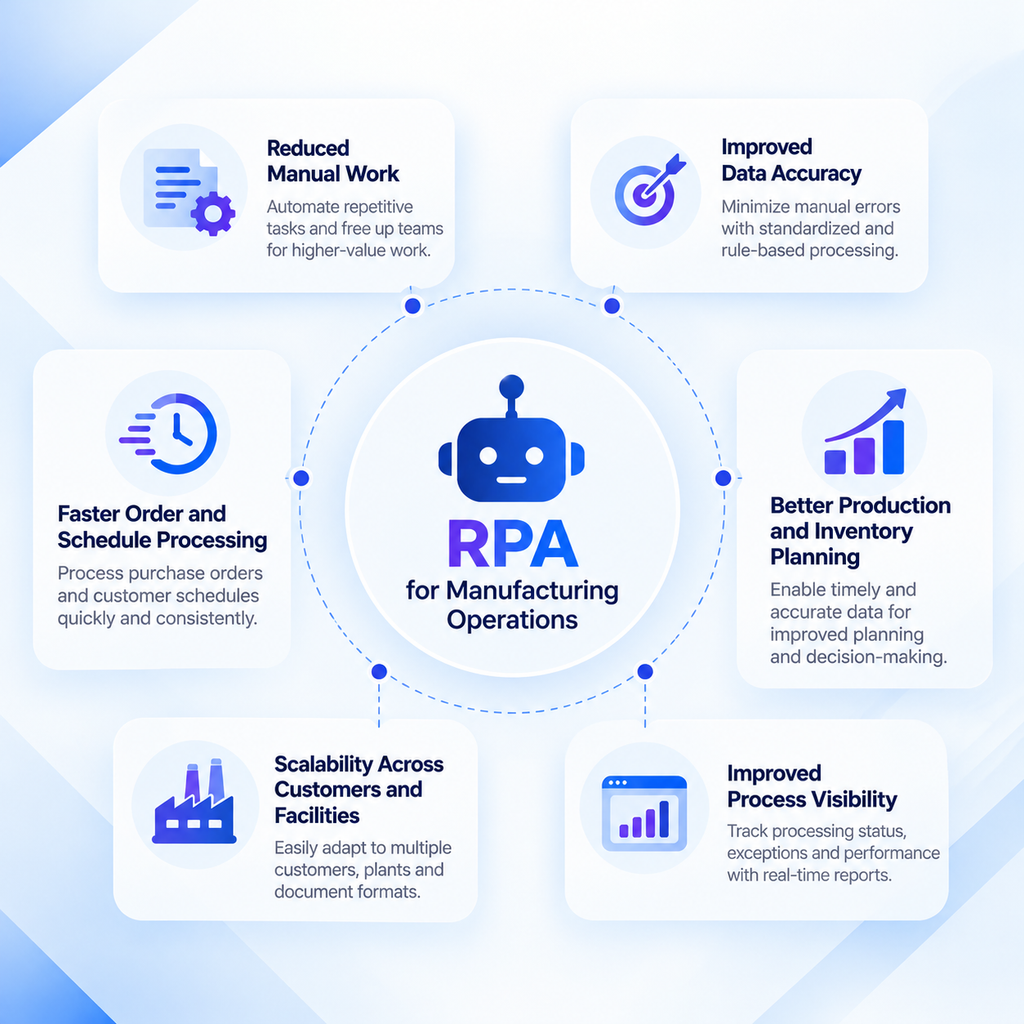
Key Benefits of RPA for Manufacturing Operations
Implementing manufacturing process automation can deliver operational improvements across procurement, order management, and supply chain functions.
Reduced Manual Work
Automating repetitive data extraction, validation, and ERP entry reduces the time employees spend handling routine transactions.
Improved Data Accuracy
Rule-based validation and standardized processing help reduce avoidable errors associated with manual data entry. Human review remains important for ambiguous or exceptional records.
Faster Order and Schedule Processing
Automated workflows can process incoming documents more consistently, helping manufacturers update operational systems sooner and respond more effectively to customer changes.
Better Production and Inventory Planning
Timely customer schedule updates improve the availability of information used for production planning, material requirements, and inventory coordination.
Scalability Across Customers and Facilities
Automation workflows can be configured for different customer-specific document structures and business rules. With appropriate governance and testing, they can be extended across additional customers, plants, and transaction volumes.
Improved Process Visibility
Centralized logs, exception reports, and processing status information make it easier to monitor workflow performance, investigate failures, and maintain audit trails.
Actual benefits depend on document quality, transaction volumes, ERP interfaces, exception rates, and the design of the automation solution.
RPA and ERP Integration in Manufacturing
ERP systems remain central to manufacturing operations, managing customer orders, purchasing, inventory, production, and delivery processes. However, not every ERP workflow is fully integrated with incoming documents and external communication channels.
RPA and ERP integration help bridge these gaps by transferring information between systems and automating transactions that otherwise require manual intervention.
For example, a manufacturer may receive customer schedules by email, extract delivery requirements from an Excel attachment, validate the information, and update the corresponding records in its ERP system. If a transaction fails because of a missing item code or an application error, the workflow can flag it for review.
Where suitable APIs are available, direct integration may be the preferred option. RPA can complement these integrations by handling repetitive tasks across interfaces that cannot be easily connected through conventional methods.
Combining RPA with document intelligence, workflow automation, and enterprise integration can create a more flexible approach to intelligent automation in manufacturing.
Why Choose Provitious Technologies for Manufacturing Automation?
Provitious Technologies helps enterprises streamline complex business processes through enterprise automation, RPA, Microsoft Power Platform, Azure AI, and system integration.
Our automation capabilities support document-heavy workflows, repetitive ERP transactions, and business processes that span multiple enterprise applications.
For manufacturing organizations, this can include automating customer order processing, purchase order workflows, delivery schedule updates, data validation, and exception handling.
Using technologies such as UiPath, Power Automate, and Azure AI Document Intelligence, we help businesses identify suitable automation opportunities and design solutions around their existing systems and operational requirements.
The objective is to reduce repetitive manual work, improve process consistency, and enable teams to focus on higher-value operational activities.
Conclusion
Automating purchase orders and customer schedules with RPA enables manufacturing enterprises to address persistent challenges in document processing, ERP data entry, and supply chain coordination.
By combining robotic automation, intelligent document processing, business-rule validation, and ERP integration, manufacturers can create more efficient and scalable workflows without necessarily replacing their existing technology infrastructure.
For enterprises handling high transaction volumes across multiple customers and facilities, RPA in manufacturing can be an important step toward more connected, reliable, and responsive operations.
Ready to identify automation opportunities in your manufacturing operations?
Connect with Provitious Technologies to explore how enterprise automation can streamline your purchase order processing, customer schedule management, and ERP workflows.
Email – info@provitious.com